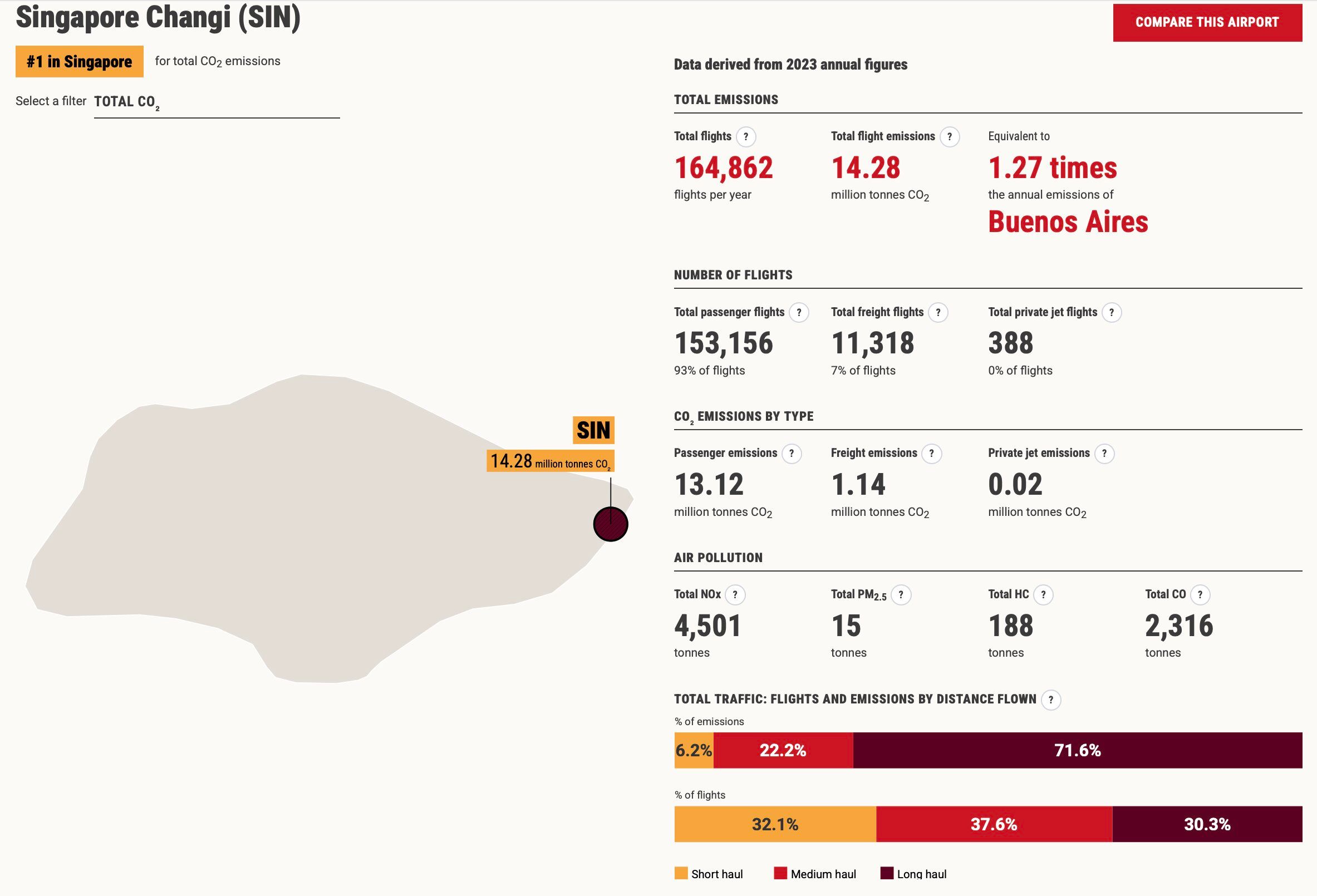
SINGAPORE: Singapore’s Changi Airport has been found to be the ninth highest contributor to global aviation pollution among airports worldwide, generating 14.28 million tonnes of carbon dioxide emissions, roughly equivalent to the amount produced by more than 20 coal-fired power stations, Business Wire reported, citing data from Airport Tracker.
Most of these emissions come from long-haul flights.
At the same time, the data reveals that the Asia-Pacific region now produces the largest share of aviation-related carbon emissions globally, at 32%.
Airport Tracker, a joint project between ODI Global, Transport and Environment (T&E) and data-providing partner International Council on Clean Transportation (ICCT), used data derived from 2023 annual figures from 1,300 airports worldwide.
This comes as the Civil Aviation Authority of Singapore (CAAS) has set a 1% sustainable aviation fuel (SAF) uplift target from 2027, with plans to raise this to between 3% and 5% by 2030, depending on global developments and SAF availability.
SAF is an alternative jet fuel that can reduce carbon emissions by up to 80%. It is produced from sources such as waste oils and fats, municipal waste, and non-food crops, and can also be made using processes that capture carbon directly from the air. The International Air Transport Association (IATA) estimates that SAF could help reduce emissions by around 65%, helping the sector reach net-zero carbon emissions by 2050.
From Jan 1, 2027, a SAF levy will be collected for flights departing Singapore, applying to tickets and services sold from Oct 1, 2026.
CAAS had initially announced in November last year that the levy would apply to tickets and services sold from April 1, 2026, but this has been revised amid the Middle East conflict.
The SAF levy will also apply to cargo shipments and general and business aviation flights departing Singapore.
Proceeds will go into a SAF Fund that will be used to procure SAF, SAF Environmental Attributes (EAs), and cover related costs. More information on applicable SAF levy amounts can be found here. /TISG
Read also: Airlines in Asia see higher demand as travellers reroute from Gulf hubs
This article (Singapore Changi Airport among highest contributor of global aviation pollution) first appeared on The Independent Singapore News.




